


Private Pay & Sliding Fee Scale
Insurance is stressful. Not having it is more stressful.

The goal of Queering The Pathways LLC is to provide quality, accessible mental healthcare. In many cases, this means working with insurance companies to decrease financial burden on clients.
There are many reasons or situations where clients may prefer a private pay option instead of using health insurance. Some example situations include (but not limited to):
You recently lost health insurance coverage (either from an employer or Medicaid)
You recently aged off of your parent’s health insurance plan and don’t have a new policy to replace it
You cannot afford a Healthcare Marketplace (ACA) plan, but do not qualify for Medicaid’s income limits
You have insurance, but cannot find a provider who accepts it
You have insurance, but you have a high deductible that you are unlikely to meet in one calendar year
You have insurance, but want more control over what services they know you receive
No matter the reason, we will work together to find a cost per session that works for both of us! Read below for more resources & information about my policies for private pay & sliding scale services.
The Green Bottle Method
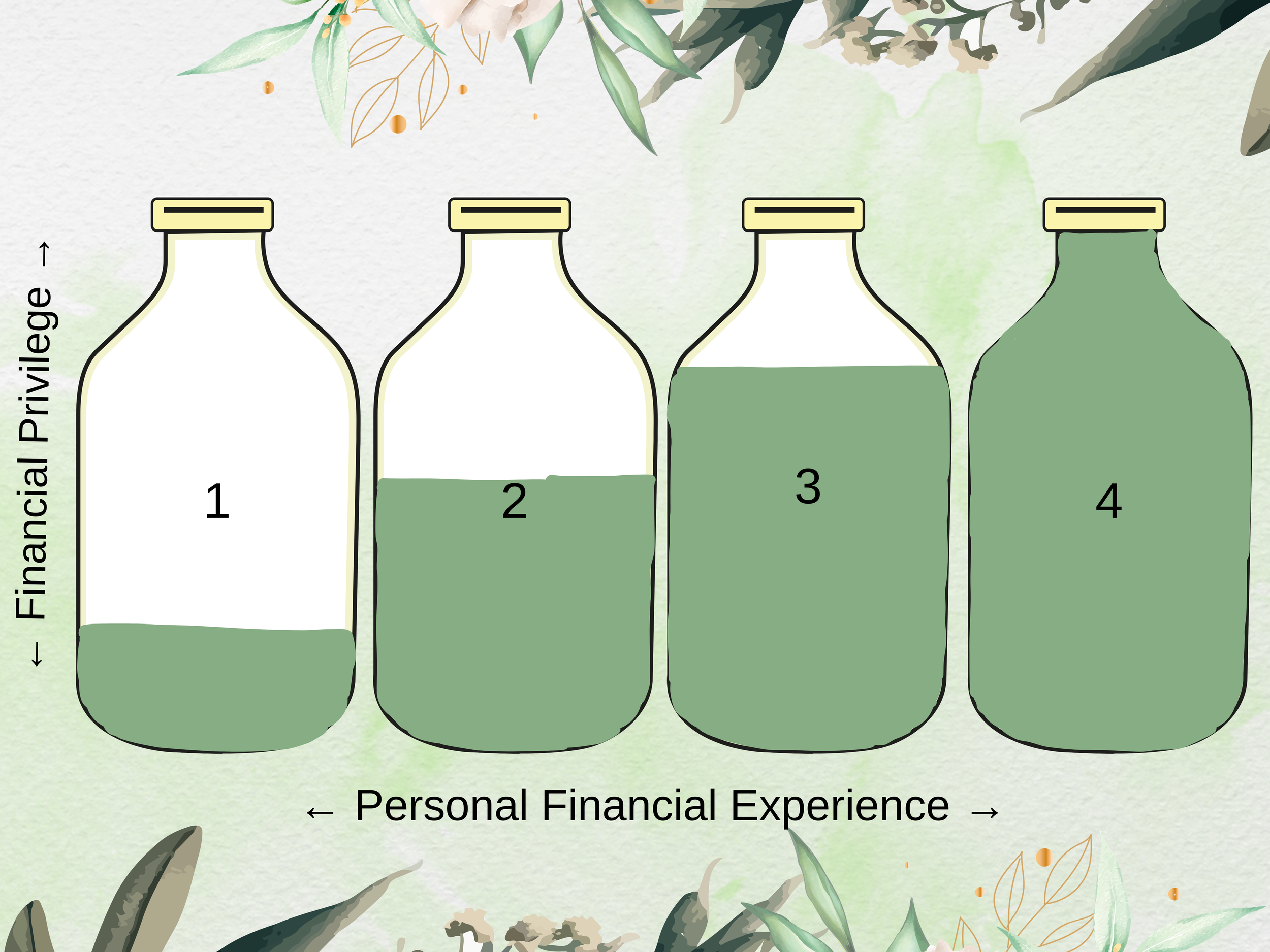
Adapted from The Sliding Scale: A Tool of Economic Justice by Alexis J. Cunningfolk, Embracing Equity, and Fiddlehead Therapy
Image Description: a light green graphic with a green floral background shows four equal-sized bottles in a row. Each bottle is numbered one through four, and is filled with slightly more liquid than the bottle to its left. The leftmost bottle (bottle one) has the least amount of liquid, while the rightmost bottle (bottle four) has the most liquid. On the vertical axis, a label in black text reads “financial privilege”; on the horizontal axis, a label in black text reads “personal financial experience”.
The Green Bottle Method is a tool of economic justice with the intention of framing a sliding fee scale around your judgement of your current financial experience in order to make services equitably affordable. Sometimes other sliding scale policies require clients to share sensitive financial information in order for their provider to determine whether they qualify for reduced fees, which can feel invasive and sometimes still not be affordable if there is more to their financial reality than is reflected on their tax return or income statements. The Green Bottle Method makes this process much more collaborative, and encourages clients to reflect on any factors which may contribute to your financial privilege, oppression, or general circumstances.
As you read & reflect upon the statements associated with each private pay range below, consider the following:
*“basic needs” refers to expenses related to living = food, water, rent/mortgage, utilities (including gas, wifi, trash/sewage, electric, etc.), transportation, etc.
**“expendable income” refers to the money you have leftover after paying bills & affording basic needs. Examples here include being able to go to the movies or a concert, going out for dinner or getting takeout, or buying a few new items each month.

bottle one
“least full”
($0-35 per session)
I stress about meeting basic* needs, and I don’t always meet them.
I have debt and it sometimes prohibits me from meeting basic needs.
I rent or have unstable housing.
I own/lease a car, but I’m not always able to afford gas; or, I have limited access to a car
I am not employed
I qualify for government assistance programs
I meet (or am close to) the current Federal Poverty Level based on my current or expected annual income (click here to check)
I have no or limited expendable** income
bottle two
“half-full”
($35-90 per session)
I have stress about meeting basic * needs, but still regularly meet them
I have some debt.
I am employed part-time or underemployed
I own or lease a car, but I am not always able to afford associated costs (registration, insurance, maintenance, gas, etc.)
I have limited access to healthcare.
My annual income is too high to qualify for Medicaid, but I cannot afford a Healthcare Marketplace plan.
I have limited financial savings
I have limited expendable** income
I have to actively save in order to take a vacation or time off.
I have had to take off work for caregiving tasks (children, elderly parents, disabled family or partner, etc.).
I am able to meet all my basic* needs
I may have debt, but can meet basic needs.
I might have some financial stress about future needs.
I own my home or rent a higher-end property
I own or lease a car
I am employed or self-employed
I have access to healthcare.
I might have access to some financial savings.
I can take an annual vacation without financial burden.
I have some expendable** income.
bottle four
“full bottle”
($150-$200
per session)
bottle three
“mostly full”
($90-150 per session)
I’m comfortably able to meet all my basic* needs.
I may have some debt but can meet basic needs.
I own my home or another property
I own a car
I’m employed or don’t need to work.
I have regular access to healthcare
I have financial savings
I have investments
I have an expendable** income.
I can always afford to buy new items when needed
I can afford to travel for pleasure and take time off for rest / vacation.
As you reflect on your personal financial experiences & financial privilege, consider the following factors that may add nuance to your decision:
Consider investing less if you:
Are supporting dependents
have other medical expenses not covered by insurance
have immigration-related expenses
are an elder (60+) with limited financial support
are an unpaid community organizer
are a returning individual who has been denied work due to incarceration history
experience discrimination in hiring or pay level
are descended from enslaved people or Native American Indians / Indigenous Americans
Consider investing more if you:
have investments, retirement accounts, or inherited money
have access to savings, family money, and resources in time of need
work part-time or are unemployed by choice
have a relatively high degree of earning power due to level of education
regularly travel, engage in recreation activities, or subscribe to arts or sports events
Consider investing the full billable cost per sessions ($200) if you:
Frequently Asked Questions
-
We know insurance jargon is incredibly confusing. Here are general definitions of what these terms mean, and how they apply to you:
An insurance premium is the amount you pay monthly to have health insurance. This is similar to a monthly gym membership - you pay it each month, and you’re allowed to use their services.
Some insurance plans have a deductible, which is the amount of money out of pocket that you are responsible for paying before your insurance starts to pay for medical services. This amount is separate from your insurance premium.
Sticking with the gym membership example: Imagine if you had a gym membership that allowed you to enter the building after you pay your monthly fee (the premium), but in order to use any gym equipment you needed to pay out of pocket for each machine before being able to use them whenever you want.
An insurance copay is a fixed, pre-determined fee that you pay when you use your health insurance to cover medical or mental health services. Sometimes an insurance plan only has a copay for services and no deductible; some plans have a copay that applies after the deductible is met. Generally this means that you pay a small fee - often anywhere from $5-$50 - and your insurance covers the remaining cost of the service. Many times, services like primary care visits or routine mental health sessions will only have a copay applied, even if you have to meet your deductible for specialist services.
In our example gym, this would be similar to each machine costing the same amount for you to use (either after or instead of meeting your deductible).
Some health insurance plans have a coinsurance instead of a copay. This is common when using out-of-network benefits. Instead of a fixed, pre-determined fee for services, a coinsurance is a pre-determined percentage split that you and your insurance will follow for a given service. Since each service likely costs a different amount from the next, the percentage split may change between providers or services.
In our example gym, this would be similar to a policy that says you will pay 30% of the fee for a given machine, and the gym will cover the other 70% of the fee.
A final common insurance term is an out-of-pocket maximum. This term includes any payments you make toward your deductible as well as any copay or coinsurance payments you make for services.
-
Description text goes here
-
Description text goes here